
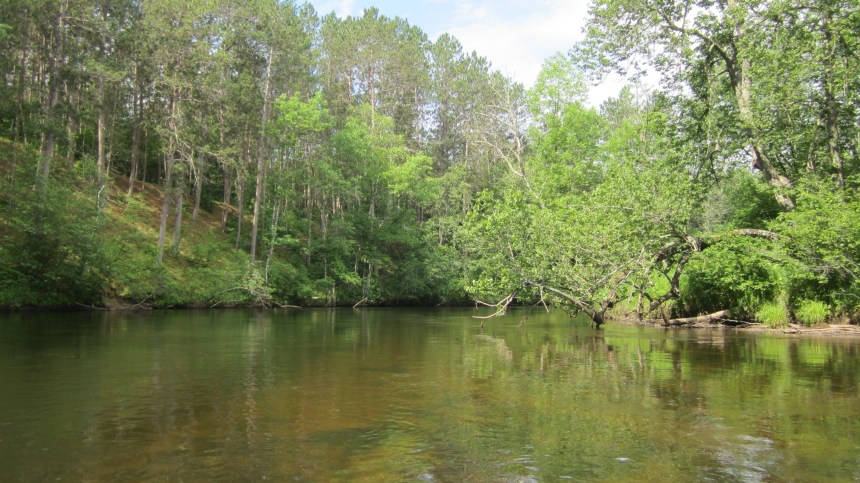
Sturgeon are sometimes referred to as living dinosaurs because they have lived in the Great Lakes region for an estimated 136 million years. In fact, the Namekagon River, which is located in northwestern Wisconsin and is the largest tributary to the St. Croix, is actually named after the Ojibwe word Namekaagong-ziibi, which means “river at the place abundant with sturgeons.”
Full-grown lake sturgeon can grow to be an astounding eight feet long and 300 pounds, but they are gentle giants that primarily eat crustaceans, mollusks, and crabs. In addition to being huge, sturgeon also live very long lives. A typical male lives to be 55 years old, while females can live 80 to 150 years.
When European-American settlers first arrived in Minnesota and Wisconsin, sturgeon were so abundant that they tangled fishing nets and toppled boats. In less than 100 years, however, the sturgeon were nearly extinct due to over-fishing. Early settlers sold sturgeon eggs as caviar, and piled their bodies along shorelines to dry, before stacking them like cord wood and burning them to fuel steam ships.

By 1920, the St. Croix, Namekagon, and Kettle Rivers were three of the only remaining rivers in Minnesota and Wisconsin where sturgeon still survived.
Eventually, the commercial sturgeon fishing craze came to an end and new harvest rules were enacted. Even so, sturgeon still struggled to rebound in an altered environment with numerous dams, which blocked their natural migration.

In the 1990s, state and tribal partners in Minnesota and Wisconsin began monitoring sturgeon populations and working to improve their habitat. The Minnesota DNR also led research on sturgeon tracking in the Mississippi, St. Croix and Chippewa Rivers. After implanting 47 fish with transmitters between 2013 and 2017, fisheries staff observed that the sturgeon swim freely between the three rivers and travel distances of 50 to 100 miles.

Today, the future of sturgeon in the St. Croix Watershed appears bright. There are an estimated 5000 sturgeon living in the lower St. Croix River and 350 in the Kettle River. In the Namekagon River, the Wisconsin DNR stocks fingerling sturgeon every year, and you can find these giant fish throughout the river below the Trego Dam. The removal of dams on the Kettle (1995) and Willow, MN (2021) have also helped sturgeon populations to recover in the upper watershed.
Sturgeon fishing is prohibited in the Kettle and Namekagon Rivers but is allowed, with strict regulations, in the St. Croix River. In the Upper St. Croix, sturgeon fishing is catch-and-release only, year round. In the Lower St. Croix, anglers can harvest one fish per calendar year during a designated time in the fall. A special tag from the Minnesota or Wisconsin DNR is required.

As for records, the largest sturgeon caught in Minnesota since the DNR began keeping track was 78 inches long and weighed 120 pounds. It was caught by Darren Troseth and John Kimble in the St. Croix River near Bayport on Feb. 9, 2019. This record-sized fish was released back to the water and may still be swimming in the St. Croix today.

 East Metro Water